

As a CFP®, Investment Advisor, and Enrolled Agent focused on turning nest eggs into income, I'm uniquely situated to work at the intersection of retirement planning, taxes, and investments.
IRAs and 401(k)s sit right in the middle of all three.
That means I see opportunities (and traps) that get missed when these aren't coordinated. This monthly newsletter shares those insights—which I hope are answers to questions you, or your clients, didn't know to ask.
Planning Insights:
This month is all about Solo 401(k)s. They are on of the most underutilized strategies I see. The good news? You can still set one up to lower your 2025 taxes, but the deadline is approaching fast. Here's what you need to know:
Who Qualifies:
- Anyone with self-employment income—W-2 from consulting, side hustle, business income. If you pay self-employment tax, you're eligible.
- No full-time employees (subject to specific definitions).
- A spousal employee is allowed if they have earnings from the business and receive a W-2.
- This includes sole proprietors, LLCs, S-Corps, Partnerships and other entity types. Each has slight variations on calculations and deadlines.
Why Solo 401(k) vs. SEP or SIMPLE:
- SEP and SIMPLE IRAs can be great options with many factors at play.
- The primary advantage of a Solo 401(k) is the ability to contribute significantly more.
- The more you earn, or the more after-tax assets you have (cash, brokerage accounts, etc.), the more beneficial it becomes.
Contribution Limits:
- You can contribute the lesser of:
- 100% of your earnings, OR
- 2025: $70,000 (+$7,500 if age 50-59, or +$11,250 if age 60-63)
- 2026: $72,000 (+$8,000 if age 50-59, or +$11,500 if age 60-63)
New Catch-Up Ages:
- If you're between 60-63, you get an enhanced catch-up contribution: $11,250 in 2025 vs. $7,500 for ages 50-59.
- That's an extra $3,750 per year during a critical pre-retirement window.
- This applies to the employee deferral portion.
Three Contribution Buckets:
- Employee deferral: $23,500 in 2025 ($31,000 age 50-59, $34,750 age 60-63) | $24,500 in 2026 ($32,500 age 50-59, $36,000 age 60-63)
- Employer contribution: ~20% of earnings (varies by entity type)
- Voluntary after-tax: Up to the overall limit above
- Can be immediately converted to Roth with no tax consequence—the "mega backdoor Roth"
Strategic Advantage: Building BOTH tax buckets
- Solo 401(k)s let you build tax-deferred AND tax-free assets simultaneously.
- Traditional contributions give you the tax deduction now. Mega backdoor Roth conversions create tax-free growth forever.
- This creates powerful flexibility in retirement: you can control your taxable income by choosing which bucket to draw from based on tax rates, Medicare premiums (IRMAA), Social Security taxation, and more.
- Especially valuable given tax law uncertainty after 2025.
Precise Tax Planning:
- You decide how to allocate across these buckets—and you can do it retroactively.
- Draft your taxes first, then fund the account for precise tax planning.
You can do this even if you have a W-2 job with a 401(k)
- This is probably MORE common than pure self-employment, but the rules are complex.
- Example: You max out your W-2 employer's 401(k) ($23,500 employee deferral) but also earn $30,000 consulting on the side. You've already used your employee deferral limit at your W-2 job, BUT you can still put that $30,000 into a Solo 401(k) using the employer contribution bucket (~$6,000) AND the after-tax bucket (remaining ~$24,000 for mega backdoor Roth).
- Work with a professional to navigate the coordination between plans.
ADVANCED TIP: You don't need cash flow from earnings to fund this.
- Many people earning $80k+ from self-employment can't max out contributions because they don't have enough cash flow after expenses.
- Here's the key: the funds don't have to come directly from your earnings. You can use existing savings—like a taxable brokerage account—to fund the plan.
- You're not saving "new" money in the traditional sense, but you're shifting assets from taxable to tax-deferred or tax-free growth.
Example:
- Jane, age 58, earns $100,000 from consulting but spends all her after-tax income on living expenses. She also has $1,000,000 in a brokerage account.
- Jane can contribute up to $80,000 to her Solo 401(k) for 2026 using brokerage funds:
- Up to $51,087 as a tax-deductible contribution, OR
- Up to $80,000 into Roth (via mega backdoor), OR
- Any combination for maximum tax optimization
- This is where retirement planning, tax strategy, and asset location intersect.
The deadline:
- If you want this for 2025 taxes, you need to act now.
- Depending on entity type, you can still establish the plan before your tax filing deadline and make a contribution.
Resource Of The Month:
MySolo401k.net - that link has any information you would care to know, and they can provide the plan documents to set this up.
What We're Doing With Clients This Month:
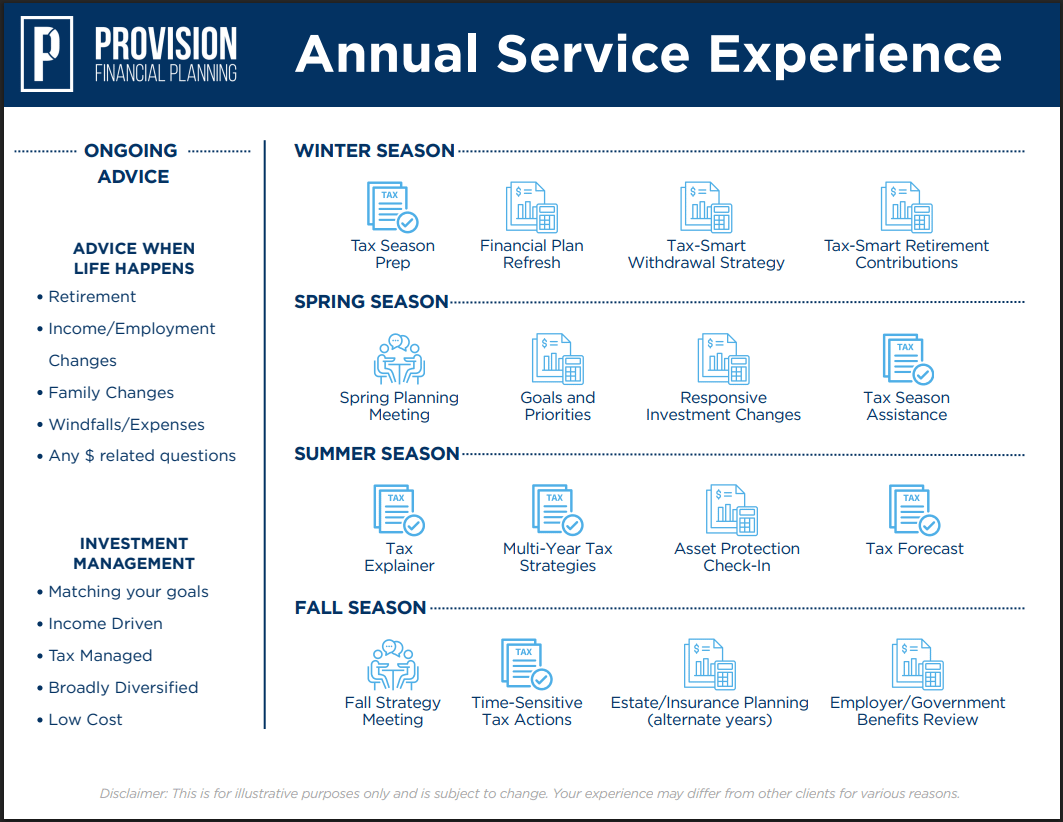
We follow a service calendar to proactively plan and prepare with our clients.
This month, we're focused on reviewing tax returns and meeting with clients for their Spring Planning Meeting to update their financial plans and adjust their asset allocations accordingly.
If you want talk specifics, please consider reaching out.